

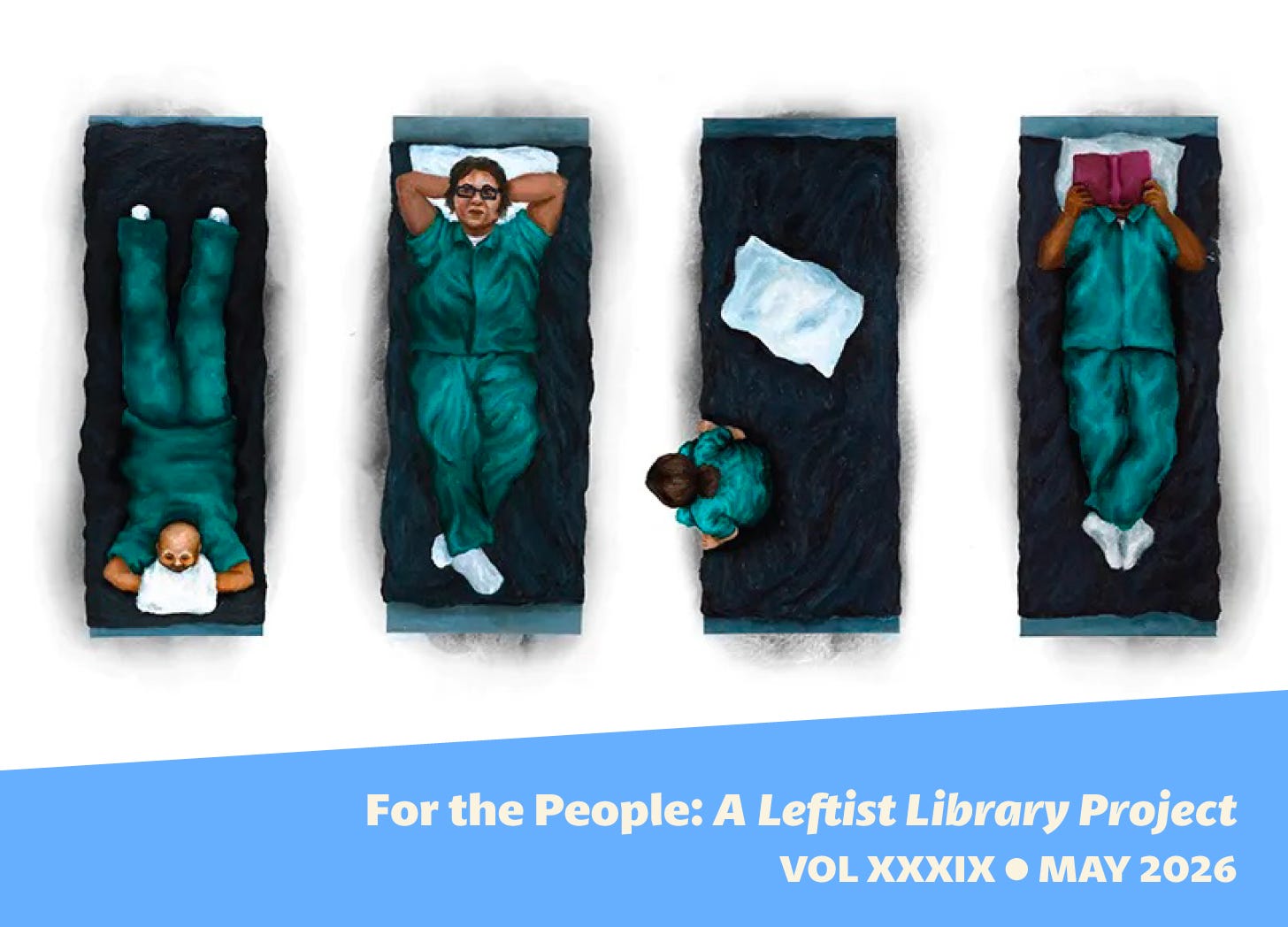
🖼️ Art in Public Libraries: The Warehouse Exhibit at Bedford Library (April 4–June 27)
By Steering Committee member, Mariame Kaba
It’s no secret that I think public libraries are essential institutions. I also believe that incorporating art in our movements for social transformation is important because art can help remove the ceiling from our imaginations. We are living in a historical moment when imagination is more important than ever. As Albert Einstein said: “Imagination is everything. It is the preview of life’s coming attractions.”
After artist Vic Liu and my comrade James Kilgore published The Warehouse: A Visual Primer of Mass Incarceration in 2024, I began a conversation with Vic about exhibiting their art in NYC. After some twists and turns, I am excited that an immersive exhibition of Vic’s large-scale paintings opened at Bedford Library on April 4.
At the heart of The Warehouse is a site-specific installation expanding upon Vic and James’s book. The library is covered with more than two dozen new, full-scale paintings by Vic that examine resistance and survival inside prisons; the emotional and political distance between “inside” and “outside;” and what abolition might look like in practice. The exhibition is spatially divided into two sections:
The Children’s Wing includes visual work and information design imagining abolition on the outside: care, safety, and accountability beyond punishment.
The Adult Wing features histories and practices of resistance on the inside, grounded in lived experience and collective struggle.
The Warehouse runs through June 27 and is open to visit when the library is. Extensive programming accompanies the exhibition. Check out the exhibition website for other programs and for more information.
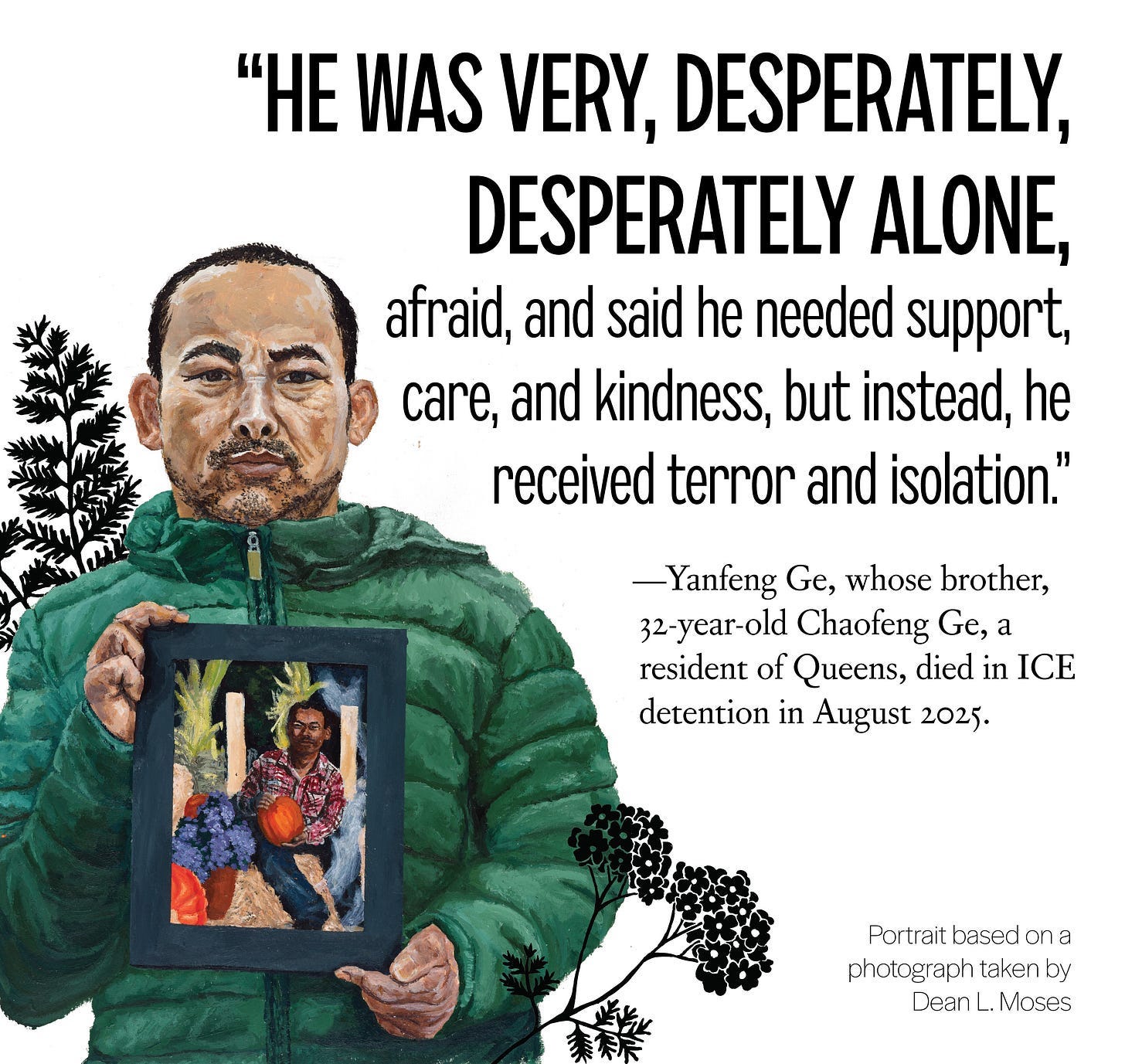
I appreciate art for many reasons. Art can encourage dissent and we need more of that in our current moment. Art is important not just because it makes us think and feel differently (which is critical), but also because it helps to disrupt patterns and old ways of thinking. Artists have the power to ask, “Why can’t we do it this way?” “Why don’t we try this?” and “Why is that not possible?” These are the kinds of questions that need to be asked now as we organize to defeat fascism.
I asked Vic some questions about the exhibition, and they generously offered their responses. I hope that each of you in the tri-state area will visit the Warehouse exhibition, participate in the associated programs, and use your radical imaginations out in the world to help end prisons and jails.
Why did you want to exhibit this art in a public library?
Every moment of this exhibition is for the people. It had to be free. I didn’t want it to be in a gallery, in a sterile space with white walls—I wanted it to be a part of our everyday world. I wanted it to be where the people are, not isolated or walled off in a place that people only visit and don’t live. I wanted people to experience the art in conversation with their daily lives, as something that is a part of their world.
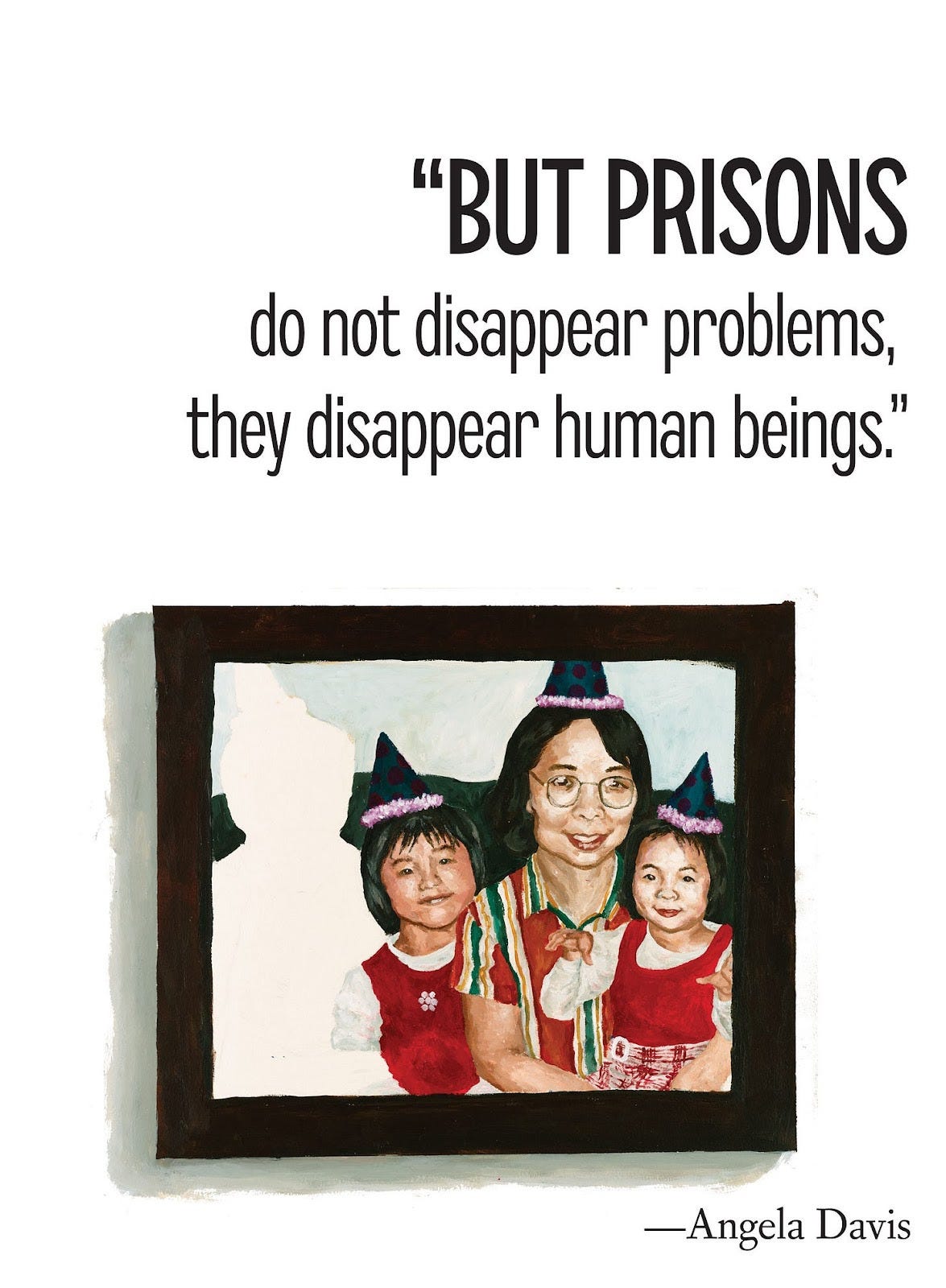
There is a powerful poignancy to placing this art about mass incarceration in a public library. In doing so, we are bringing together one of the worst things the state does with one of the best.
What have you learned from incarcerated people about making art?
As my co-author James has said, prisons are a hotbed of art. He wrote four books during his time in prison, two by hand with tiny golf pencils. There is so much incredible art made inside prison walls, like Dean Gillespie’s miniatures, or Carole Alden’s crocheted Fish House.
It makes a lot of sense to me. Art is how I understand and respond to the world. In prison, you are constantly immersed in the best and worst of humans, in both the darkest horrors as well as decency, dignity, and kindness. I understand how this intense proximity with the extremes of humanity feeds an urge to create and dream.
It reminds me of how so much art was also created in concentration camps during the Holocaust. In prison, toilet paper and water can be used to sculpt or build objects like the chess pieces in the exhibition. In concentration camps, people would use chewed bread and saliva to sculpt small figurines or rosaries.
Making art is deeply human. Perhaps it is even one of the best things that humans can do. Humans find meaning and dignity in the darkest of places, and art is one of the ways they do so.
How do you think that art relates to organizing? Do you think art matters under fascism? How?
People often ask, “what makes art good?” Which is a very different question than what makes art expensive, or what gives art status.
Art at its most powerful speaks on the human condition. Art belongs to everyone, in that I think it is an innately human thing to do, to create and dream. When I say art, I don’t mean art as defined by institutions, art with wall plaques and price tags. I mean art like something made by someone meant to express something. The uncomfortable vagueness of this definition is essential, because art is everywhere. Art is an articulation of self, of all of the things that make you who you are, and because of that, art is always political. Art bridges the gaps between us. It connects us, and connection is where we can draw power. Visual art is as much a part of organizing as writing or speaking or gathering.
I sometimes question what art can do while the state wages war against our bodies. It’s a very hard time to be a human (though, arguably, it has always been a hard time to be a human, a fact that inspires me rather than demeans our current struggle). No, you can’t eat a painting. But you also can’t live without art.
Art holds a mirror to who we are as a people. Crucially, because it holds a mirror not only to our flaws but also to our possibilities, it allows us to dream of what we can be. Art is neither neutral nor passive. Inherent in every piece of art is an action, a declaration, an ask of the viewer to re-evaluate the world around them.
Fascism is constantly and deliberately shrinking the definition of who is considered a person. Art, especially art made by and for marginalized populations, does the opposite. It expands and complicates our understanding of the human condition.
Art goes everywhere humans go. The fascists are human too, so they also have art, along with the money and power to elevate it. But art, just like this world, is all of ours. It is ours to create, to dream, to share, to grieve, to cherish, and to change.
What do you hope that visitors take away from the exhibition?
Our visitors will come from a wide spectrum of proximity to incarceration. Some will be formerly incarcerated, some will have family members or friends who have been incarcerated, some people will have deep familiarity with prisons and all of their forms, and some will be very new to the issue.
For the visitors who have been personally impacted by incarceration, I hope that they feel seen by the exhibition. It is for them.
This exhibition is also for visitors who are new to the topic, who maybe haven’t visited a prison or don’t know anyone who has been incarcerated. I want this exhibition to chip away at the massive barrier between life inside prison and life outside. I hope that the exhibition will help visitors see the stories and people that the state desperately wants to hide from us. I hope people walk away with the will to change it.
I want people to join us, to build friendships with people inside, to protest the building of new prisons and new ICE detention facilities (jails), to join or start mutual aid groups, to meet their neighbors and do the hard work of building community and being there for each other. I want people to talk about incarceration and prisons. I want people to not just give a one-time donation to a bail fund, I want them to change how they move through the world. I want them to understand that this issue is theirs too, that we have the responsibility and the ability to rebuild our world without prisons. As they leave the exhibition and continue on with their lives, as they buy their groceries and ride the subway, I want people to remember our community inside.
Our website is live, thanks to the brilliant work of Dani Blum. Our instagram is also live.
🗓️ FTP Events
FTP’s Friends & Foundations Network helps folks strengthen and protect their libraries by getting involved with a Friends of the Library or Foundation group! We meet on the 4th Wednesday of every month. Our next meeting is on May 27 from 6:30 – 8:00 pm ET (3:30 – 5 pm PT)—register and learn more here!
FTP’s Trustee Network connects elected and appointed library trustees across the country to talk about what’s happening in our library systems and how we can solve big problems together. Participants in prior cohorts are always welcome, as are currently serving leftist trustees. We meet the second Tuesday of each month, and our next meeting is on May 14th from 8-9pm ET (5-6pm PT); if you’re not already on the calendar invite or email list, please email us for more info on how to join!
Local Library of the month!
This month’s local library is Milton H. Latter Memorial Library! Written by Corsiatto
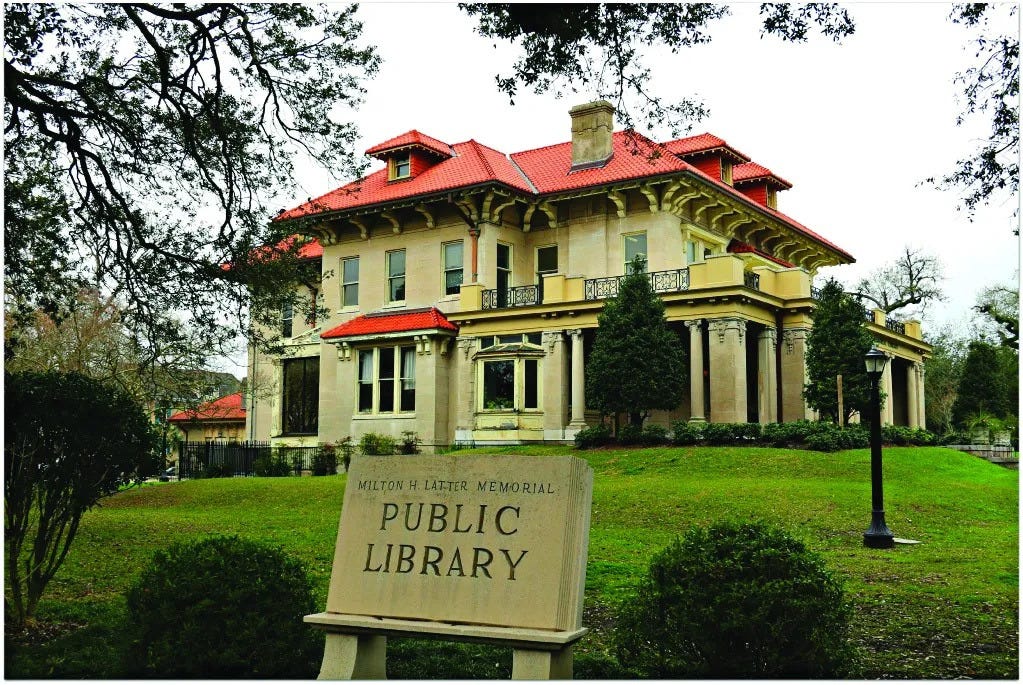
Over a century old, the building, now known as the Milton H. Latter Memorial Library, serves as a branch of the New Orleans Public Library system. Being able to read books while seated in a place of New Orleans uptown history makes me feel connected to the city in ways you can’t even imagine. I love their monthly book sales too! This branch also hosts fun free events that are geared toward locals.
We want to feature your local library in our newsletter! Thanks to Corsiatto for writing in this month. Send us a photo and 100 words about what your library means to you and your community.
🏛️ Library Land Updates
Here’s a roundup of interesting reading and listening material that we think you’ll appreciate. Sometimes articles may be paywalled. In other news, sometimes it’s nice to use tools like Archive.today or the Wayback Machine.
CPS students can now access books, tutoring, other library services with just a student ID by Emmanuel Camarillo for Chicago Sun Times
South Milwaukee voters approve library funding referendum by Erik S. Hanley for the Milwaukee Journal Sentinel
Irving Public Library Board seeks to alter key policy language, remove most mentions of ‘diversity’ by Andy Lusk
Workers say Columbus Metropolitan Library management is union-busting – Matter News by Larkin Cleland
Maryland Eastern Shore Public Libraries to lose access to popular digital media service Hoopla | wboc.com by Stella Guzick
‘BLOCKADE’: The Right Is Using AI Content Scanners to Try to Supercharge Book Banning by Claire Woodcock for 404 Media
PLA 2026: Public Librarians ‘Bring the Sunshine’ to Minneapolis By Nathalie op de Beeck for Publishers Weekly
An IMLS Court Victory; New Budget Battle Begins | School Library Journal by Jennifer A. Dixon and Kara Yorio
The Free Library is looking to add Sunday hours at several branches by Nate File for The Philadelphia Inquirer
Minnesota Supreme Court Will Hear Case of a Trans Librarian Dismissed By Catholic School - New Ways Ministry by Lynnzee Dick
How libraries in Japan are being reimagined as pillars of community life by Naoko Tochibayashi for World Economic Forum
Why libraries really matter right now by Kelly Richards, for The Inquirer [gift link]
📢 Take Action
Deadline: June 15 | Send your zines to the Zine Pavilion at ALA Annual 2026 in Chicago. Mail your zines to: ALA Zine Pavilion 3 Elm Creek Drive #310 Elmhurst, IL 60126
NYC: Get involved in the fight to adequately fund our public libraries through NYC PLAN.
Seattle: Public Library Action Network (PLAN). Not related to NYC PLAN. Sign up for the Public Library Action Network (PLAN) to get updates on policy decisions and funding opportunities that impact The Seattle Public Library at the local, state, and federal levels. Learn about how you can take action to help keep your Library strong — get with the PLAN!
🎟️ Upcoming Events of Interest
📚May 1, 2 | Vermillion, SD Vermillion Zine Fest at various locations.
📚May 2 | Davis, CA | 12 pm–4 pm Print & Zine Fest at the Third Space Art Collective
📚May 2 | Santa Rosa, CA | 12 pm–5 pm Santa Rosa Zine Fest at the Northwest Santa Rosa Library
📚May 9 | New York, NY Black Zine Fair. The Black Zine Fair is a celebration of all things Black and independent publishing in New York City! RSVP to attend here.
📚May 16 | Lexington, KY Halftone Zine Fest at UK School of Art & Visual Studies
📚May 16 | Detroit, MI | 12 pm–6 pm Detroit Zine Fest at the Jam Handy
🗓️Deadline | May 23 | Grand Rapids, MI Apply to table at the Grand Rapids Zine Fest
📚May 30 | Olympia, WA | 11 am–4 pm Olympia Zine Fest at the Olympia Center, 222 Columbia St NW. Masks are required and will be provided.
📚May 31 | Long Beach, CA Biggest Little Zine Fair (BLZF). BLZF is a free-to-attend outdoor zine fair. All zine tables are vended by BLZF staff, and showcase purchasable zines from all over the world.